
Cleobetra regulation and licence guide
Cleobetra Licence and UK Status: UKGC, Anjouan and Player Protections
 Available in GB
No matching UK Gambling Commission licence appears for Cleobetra in the current public register. Cleobetra is identified by independent sources as operating under an Anjouan licence, but a current official licence number and expiry date are not stated here because they are not available from the official information used for this page. For consumers in Great Britain, the regulatory rule is separate from the offshore licence: the UK Gambling Commission says a remote casino operator providing gambling to consumers in England, Scotland or Wales needs a UKGC licence. Northern Ireland has a different legal framework and should not be folded into the Great Britain rule. The licence position is best considered by jurisdiction rather than reduced to a blanket legal or illegal label.

Table of Contents
- Cleobetra licence status at a glance
- What the UK Gambling Commission requires in Great Britain
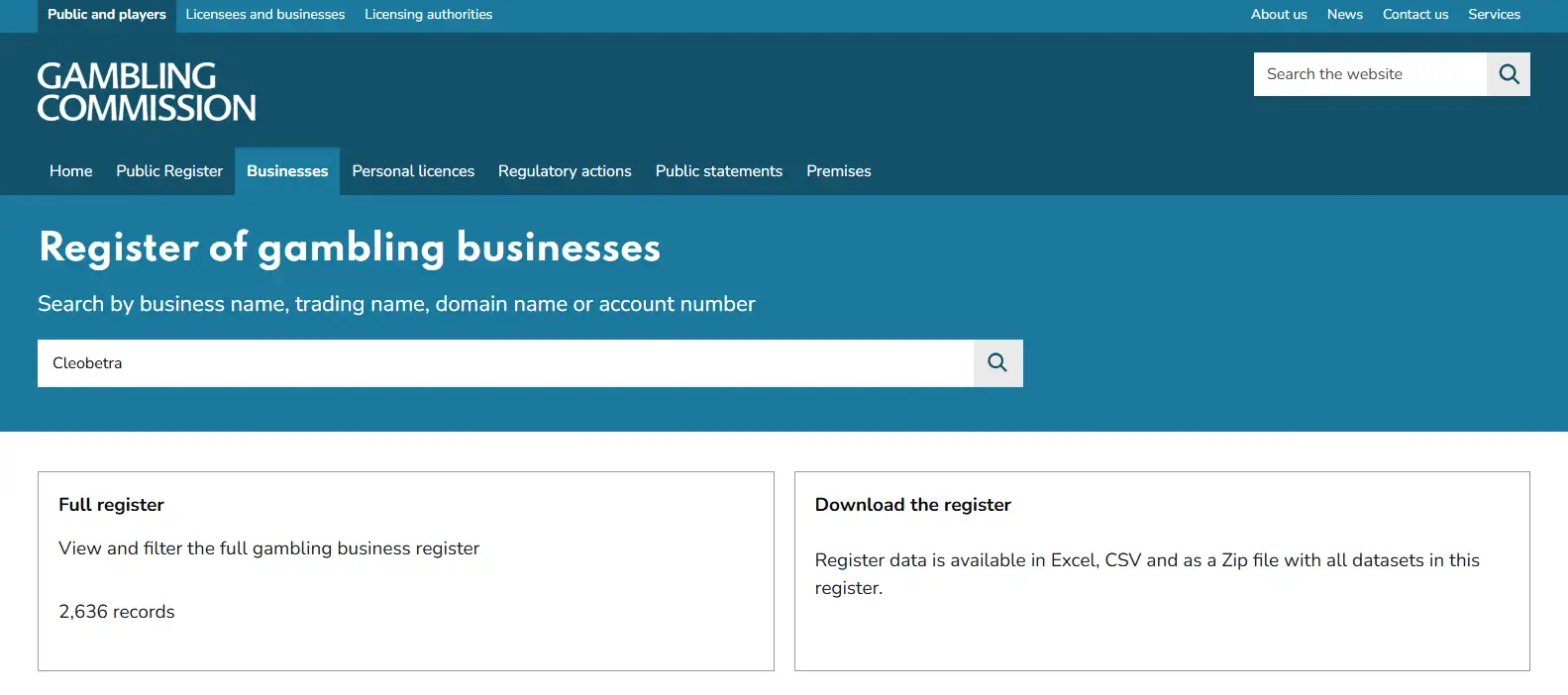
- Cleobetra in the UKGC public register
- What Cleobetra’s Anjouan licence does and does not establish
- Which UKGC protections should not be attributed to Cleobetra
- Great Britain and Northern Ireland are not the same regulatory scope
- How to verify a casino licence instead of relying on a footer badge
- What a UKGC register match would change
- How to interpret a missing UKGC match carefully
- Common licence-check mistakes to avoid
- How licence status affects other Cleobetra review topics
- What Cleobetra’s licence position means for players in Great Britain
Cleobetra licence status at a glance
| Question | Verified position | What it means |
|---|---|---|
| UKGC licence for Cleobetra | No UKGC licence verified | Do not describe Cleobetra as UKGC licensed or attach UKGC licensee protections to the brand. |
| Offshore licence jurisdiction | Anjouan, Union of Comoros | The offshore licence is a different regulatory relationship from a Great Britain operating licence. |
| Exact Anjouan licence number or expiry | Not published here | A specific number or expiry needs direct current registry or operator licence-page verification. |
| Great Britain remote casino rule | UKGC licence required | Operators providing remote gambling to consumers in England, Scotland and Wales need the relevant UKGC licence. |
| Northern Ireland | Separate framework | UKGC does not regulate remote gambling activity there in the same way as in Great Britain. |
The most important distinction is between a licence that exists somewhere and the licence required for a particular jurisdiction. An Anjouan licence does not become a UKGC licence because a website is accessible to a British reader, and the absence of a UKGC register hit should not be replaced with an assumption about equivalent protection.
What the UK Gambling Commission requires in Great Britain
The UK Gambling Commission states that a business needs a licence from the Commission if it provides remote gambling facilities to consumers in Great Britain. Its remote casino licence guidance applies whether the operator is based in Britain or elsewhere. Great Britain in this context means England, Scotland and Wales.
That rule is about the operator’s relationship with the British regulatory system. It is not a statement about whether an offshore licence exists, whether a site has an English-language interface or whether a player can technically reach a registration page. Those are separate facts. For licensing, the relevant question is whether the operator appears in the UK Gambling Commission business register under its business name, trading name or domain.
Why this distinction matters
A casino can have an offshore licence and still be outside the UKGC licensing framework. When comparing consumer protections, the regulator that issued the licence is more important than the simple word “licensed”.
Cleobetra in the UKGC public register
The UKGC public business register does not show a matching local licence entry for Cleobetra, NovaForge or Nova Forge under those names or the cleobetra.com domain. The public register itself is the correct primary source for this question because it is where the Commission publishes gambling-business licence records.
A register hit would provide a regulator-backed basis for saying that a named business holds a UKGC operating licence and for checking the status of that licence. Without a matching hit, this site does not describe Cleobetra as UKGC licensed, does not assign the brand UKGC consumer-protection coverage and does not infer membership of a UK dispute-resolution arrangement.
This is deliberately narrower than saying that Cleobetra is “legal” or “illegal” in the UK. Those blanket labels can hide the difference between the operator’s licence status, the regulatory rule that applies to businesses, and the position of an individual user. The relevant licence result is that no matching UKGC licence appears for Cleobetra in the public register.
What Cleobetra’s Anjouan licence does and does not establish
Two independent industry reviews identify Cleobetra as operating under an offshore Anjouan licence. Anjouan is part of the Union of Comoros and is not the UK Gambling Commission. The licence therefore tells you that Cleobetra is associated with an offshore licensing jurisdiction, not that it has passed the UKGC application, compliance and ongoing supervision process for Great Britain.
This page intentionally stops at the jurisdiction. A specific offshore licence number, issue date or expiry date is not published without direct current registry verification. That avoids turning a secondary-source identifier into a primary-source licence claim. If Cleobetra later publishes verifiable registry details, those details should be checked against the issuing authority before being added.
The distinction is useful when reading casino reviews because phrases such as “licensed casino” can be technically true while still leaving the reader with the wrong impression about which regulator stands behind the licence. The jurisdiction name should always travel with the licence claim.
Which UKGC protections should not be attributed to Cleobetra
Because no matching UKGC licence appears for Cleobetra, do not assume protections or obligations that depend on UKGC licensee status apply to the brand. That includes describing the operator as supervised by the Commission, presenting the UKGC as Cleobetra’s complaint handler, or assuming that UKGC-specific licensee arrangements apply to the account.
The distinction also matters when discussing self-exclusion and complaints. Those topics have their own evidence and should not be inferred from a licence label. The dedicated Cleobetra and GamStop page examines the self-exclusion question, while the Cleobetra complaints page focuses on complaint routes and reputation evidence. Keeping those issues on separate pages prevents one licensing fact from being stretched into claims about every consumer-protection mechanism.
Great Britain and Northern Ireland are not the same regulatory scope
The UKGC’s main gambling jurisdiction under the Gambling Act 2005 covers Great Britain: England, Scotland and Wales. Its own Northern Ireland guidance says the Commission does not regulate gambling activity in Northern Ireland in the same way because gambling there is a devolved matter. Northern Ireland is governed primarily by the Betting, Gaming, Lotteries and Amusements (Northern Ireland) Order 1985 as amended in 2022.
There are still UKGC-linked rules that can matter around operators with equipment in Great Britain and advertising into Northern Ireland, so the distinction is not simply “UKGC has nothing to do with Northern Ireland”. The useful consumer-level point is narrower: a statement about the Great Britain remote-casino licensing requirement should not automatically be presented as the complete legal framework for Northern Ireland.
For this reason, this site uses “Great Britain” when describing the direct UKGC remote-operator licensing requirement and uses “UK” only where the context does not erase the Northern Ireland distinction.
How to verify a casino licence instead of relying on a footer badge
A licence check should begin with the regulator, not with a logo or text block on the casino website. For a Great Britain claim, use the UKGC business register and search the business name, trading name and domain. Confirm that the entry belongs to the same operator and website you are assessing, then read the current licence status rather than assuming that an old screenshot or review remains valid.
For an offshore claim, the same principle applies: identify the issuing jurisdiction, locate the regulator or registry that can confirm the record, and match the entity and domain. A third-party page can point you towards a source, but a licence number or expiry date is stronger when the issuing authority confirms it directly.
- Identify the regulator named in the licence claim.
- Search the regulator’s current public register for the operator and domain.
- Match the legal entity and trading or domain information.
- Check whether the licence is active, suspended, revoked, expired or otherwise limited.
- Keep the jurisdiction attached to the conclusion instead of calling every licence a UK licence.
What a UKGC register match would change
A genuine UKGC register match would change the wording of this page because it would provide primary regulator evidence for a Great Britain licence claim. The relevant entry would need to match the operator or trading identity and the domain being reviewed, not merely contain a similar company name. The licence status would then matter as much as the match itself, because an active entry is different from one that is surrendered, suspended, revoked or expired.
That is why a badge, footer statement or secondary review is not a substitute for the register. A brand can change operators, domains can move between licence holders and old reviews can remain online after a status change. The regulator record provides the current reference point. Unless a matching Cleobetra entry appears in the UKGC public register, do not treat the brand as UKGC licensed.
How to interpret a missing UKGC match carefully
The absence of a matching entry is important, but it should be read precisely: the public register does not show a Cleobetra UKGC licence. It does not by itself prove every possible legal conclusion about every person, transaction or territory. Do not turn that register result into a blanket verdict covering every person, transaction or UK jurisdiction.
For Great Britain, the regulator’s licensing rule is clear: businesses providing remote gambling facilities to consumers there need the relevant Commission licence. For Cleobetra specifically, no matching licence appears in the UKGC public register. Putting those two facts next to each other gives readers the regulatory context without inventing a court judgment, enforcement finding or player-specific legal conclusion that the sources do not provide.
For a reader comparing operators, the useful consequence is methodological: keep the register result separate from product quality. A wide game lobby, active promotions or convenient mobile access cannot substitute for a local licence check, just as a missing local licence does not erase independently verified product features. Treating those questions separately makes the comparison clearer and prevents the word “licensed” from being interpreted more broadly than the identified jurisdiction supports.
Common licence-check mistakes to avoid
One mistake is treating an offshore jurisdiction name as if it were a UK authorisation. Another is relying on a licence number copied from a review without checking the issuing registry. A third is searching only the consumer-facing brand name and ignoring the operator name or domain. Finally, an old screenshot should not be treated as current evidence when the regulator maintains a live register.
For Cleobetra, those mistakes matter because the verified picture contains two different regulatory facts at once: an Anjouan licence position and no verified UKGC licence. Keeping both facts visible prevents the word “licensed” from doing more work than the evidence supports.
How licence status affects other Cleobetra review topics
A missing UKGC licence does not automatically make every other Cleobetra fact uncertain. The game library, payment categories, support channels, mobile access and bonus terms are separate product facts and should be verified from their own sources. The Cleobetra payments page, for example, can describe verified payment categories without pretending that those methods prove UKGC authorisation.
The reverse is also true. A well-documented game library or fast mobile site does not prove a local licence. Keeping those evidence streams separate produces a more useful review because readers can compare product quality and regulatory position without one being used as a substitute for the other.
That separation is especially important for a newer brand. Regulatory status can change, registers can be updated and product features can change independently. A licence page should therefore be date-sensitive and regulator-led, while feature pages should use their own current evidence.
What Cleobetra’s licence position means for players in Great Britain
For a reader in England, Scotland or Wales, the position is straightforward but not binary. Cleobetra has an offshore Anjouan licence position, while no matching UKGC licence appears for the brand in the current public register. The UK Gambling Commission states that remote casino operators serving consumers in Great Britain need the relevant UKGC licence. Do not treat Cleobetra as UKGC regulated or assume UKGC licensee protections apply to the brand.
The practical decision is to keep the jurisdictions separate: judge the casino’s features separately, judge the licence by the regulator that actually issued it, and do not treat an offshore licence as equivalent to a Great Britain operating licence. Northern Ireland also needs its own legal context rather than a copied Great Britain conclusion. For the full product view alongside this regulatory position, return to the Cleobetra UK review.
Created by the ”Cleobetra Casino” editorial team.